
7 Factors to Choose Returns Management Software
3 August 2026
Choosing the right returns management software requires more than comparing features. Fashion brands must assess the capabilities that directly affect performance, cost and customer experience.
Quick guide: 7 key factors for evaluating returns management software
When you’re running a large-scale fashion operation, returns aren’t a back-office task. They’re a direct line to your margins, your customer loyalty, and your sustainability commitments. Yet choosing the right returns management software is rarely straightforward.
This guide breaks down the seven factors that matter most when evaluating returns providers. Each one connects directly to the operational realities of running cross-border fashion logistics at scale.
Table of Contents
- Scalability and volume handling
- Cross-border logistics capability
- Sustainability and circular outcomes
- Customer-experience
- Data visibility and analytics
- Fraud prevention and margin protection
- Total cost of ownership
- Fraud prevention and margin protection
- How to approach your returns challenges
- Frequently Asked Questions (FAQs)
How we identified these evaluation criteria
These factors emerged from the real-world challenges large fashion brands face when managing high-volume returns across multiple markets. Rather than focusing on feature checklists, we concentrated on capabilities that directly affect operational efficiency, cost control, and customer experience.
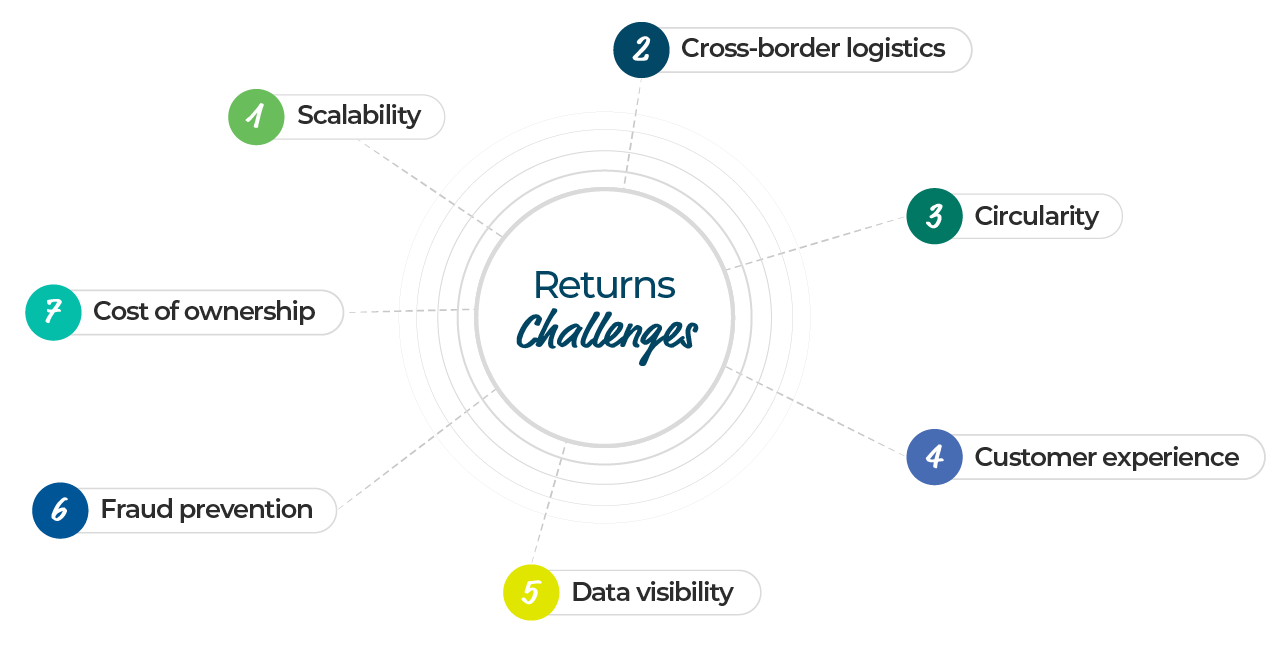
- Scalability under pressure: Can the platform handle seasonal spikes without creating warehouse backlogs or refund delays?
- Cross-border capabilities: Can you manage international returns through a single integration rather than separate country-by-country processes?
- Sustainability credentials: Does the provider offer circular pathways for returned goods, including resale, repair, and recycling?
- Customer experience impact: Does the platform reduce customer service volume while speeding up refunds?
- Data and visibility: Can you access returns analytics that inform product development and reduce future return rates?
- Fraud prevention: Does the system protect margins without adding unnecessary steps for legitimate customers?
- Total cost of ownership: Beyond per-parcel fees, what are the hidden costs of product depreciation, warehouse space, and carrier management?
1. Scalability and volume handling
Fashion retail operates in peaks and valleys. Your returns management software needs to absorb those fluctuations without creating operational bottlenecks. That means automated routing, priority processing for time-sensitive items, and the ability to scale warehouse capacity as needed.
Large fashion brands can process millions of return transactions annually. The difference between a provider that handles this smoothly and one that creates backlogs during peak periods directly affects your refund speed and customer satisfaction.
ReBound maintains efficient returns flow even during peak volumes through a decentralised network of warehouses across Europe. This distributed approach means returned items reach processing centres faster, reducing the depreciation that occurs when fashion items sit in transit too long.
What to look for in scalability
- Automated return routing based on item type, condition, and destination
- Real-time capacity visibility across the warehouse network
- Flexible carrier options that adjust to volume without renegotiating contracts
- Processing SLAs that hold up during promotional periods
2. Cross-border logistics capability
If you’re selling fashion across Europe or globally, managing returns through separate country processes creates complexity and cost. Each additional carrier contract, customs process, and local warehouse relationship adds operational overhead.
The EU’s recent changes to customs duty exemptions have made cross-border returns more expensive. Items valued at €150 or less are no longer exempt from customs duty when returned from outside the EU. For fashion brands with high international return volumes, this represents a significant cost increase.
A single integration that handles cross-border returns across markets reduces both administrative burden and per-parcel costs. ReBound’s international logistics network connects brands with local carriers in 150+ countries, allowing you to offer customers familiar return options without managing those relationships directly.
Cross-border evaluation checklist
- Single point of contact for returns across all European markets
- Pre-built carrier integrations that don’t require IT investment
- Automated customs documentation for international returns
- Multilingual returns portal with local currency support
- Consolidated shipments that reduce per-unit shipping costs
3. Sustainability and circular outcomes
With the EU’s Ecodesign for Sustainable Products Regulation (ESPR) introducing a ban on destroying unsold apparel, footwear, and clothing accessories for large companies from July 2026, sustainability is no longer optional. Your returns provider needs to offer compliant circular routes for products that can’t go back to primary stock.
Forward-thinking fashion retailers are recognising this as an opportunity rather than just a compliance burden. Sustainable returns practices can recover value from items that would otherwise be written off, turning a cost centre into a revenue stream.
ReBound’s circularity services include repair, resale, donation, and recycling pathways. The intelligent return disposition system assesses each returned item and routes it to the most appropriate outcome based on condition, value, and demand.
Sustainability capabilities to evaluate
- Inspection and grading capabilities that determine resale potential
- Repair and refurbishment workflows for repairable items
- Resale channel integrations for B-stock and outlet inventory
- Donation and recycling partnerships for items beyond commercial use
- Carbon footprint tracking and emissions reporting
4. Customer experience and refund speed
Studies show that customers with a positive returns experience are significantly more likely to make repeat purchases. Conversely, research indicates that 71% of shoppers are less likely to use a retailer again after a poor returns experience.
When shoppers initiate a return, they’re already in a negative state of mind. The faster and easier you make the process, the more likely you are to retain their future business. That means offering multiple return methods, providing real-time tracking, and issuing refunds before items complete the full journey back to your warehouse.
ReBound gives customers faster refunds through local inspection and processing. Because returned items are assessed at decentralised warehouses rather than waiting to reach a central facility, you can trigger refunds days earlier than traditional models allow.
Customer experience benchmarks
- Multiple return options including drop-off points, lockers, and home pickup
- Branded returns portal that maintains your customer experience
- Proactive notifications that reduce “where’s my refund” enquiries
- Refund timing tied to carrier scan rather than warehouse receipt
- Easy exchange options that retain revenue in your business
5. Data visibility and analytics
Returns data tells you why customers are sending products back. Without visibility into return reasons by SKU, by market, and by time period, you’re missing insights that could reduce your return rate and improve your products.
The right returns management platform captures structured data at the point of return initiation and throughout the processing journey. This creates a feedback loop that connects post-purchase behaviour to product development and marketing decisions.
ReBound’s data and insights capabilities show you what’s driving returns and where intervention could prevent them. That might mean adjusting size guides, improving product photography, or reconsidering fabric choices on specific lines.
Data capabilities to prioritise
- Return reason analytics broken down by product, category, and market
- Processing time metrics across the returns lifecycle
- Customer sentiment tracking through return feedback
- Integration with your BI tools and data warehouse
- Predictive analytics for incoming return volumes
6. Fraud prevention and margin protection
Returns fraud now accounts for a significant portion of all returns, representing substantial lost revenue for fashion retailers. Common fraud types include wardrobing (wearing items and returning them), empty box returns, and returning counterfeit items.
The challenge is balancing fraud prevention with customer experience. Adding too much verification slows down legitimate returns and frustrates good customers. Too little verification leaves your margins exposed.
ReBound’s approach combines AI-powered fraud detection with physical verification at processing centres. Rather than relying on behavioural data alone, the system verifies what’s actually in the returned package, catching discrepancies before refunds are issued.
Fraud prevention considerations
- Automated flagging of suspicious return patterns
- Physical verification capabilities at processing centres
- Flexible rules that adjust based on customer history and order value
- Balance between protection and customer friction
- Clear audit trails for disputed returns
7. Total cost of ownership
The per-parcel shipping cost is just one component of what returns actually cost your business. Hidden costs include product depreciation during transit, warehouse space allocated to returns processing, customer service time handling return enquiries, and the IT investment required to integrate new carriers and systems.
When you work with a returns specialist, you gain access to carrier networks and warehouse infrastructure that would cost significantly more to build independently. The management overhead of maintaining carrier contracts and partner relationships transfers to your provider.
ReBound helps you identify and address these hidden return costs through consolidated shipments, local processing that reduces transit time, and rework capabilities that return items to sellable condition without requiring internal warehouse resources.
Cost factors beyond shipping
- Product value depreciation during the returns cycle
- Customer acquisition cost to replace churned customers
- Customer service resources allocated to return enquiries
- Warehouse space and staff for returns processing
- IT investment for carrier and system integrations
How do these factors connect to your current returns challenges?
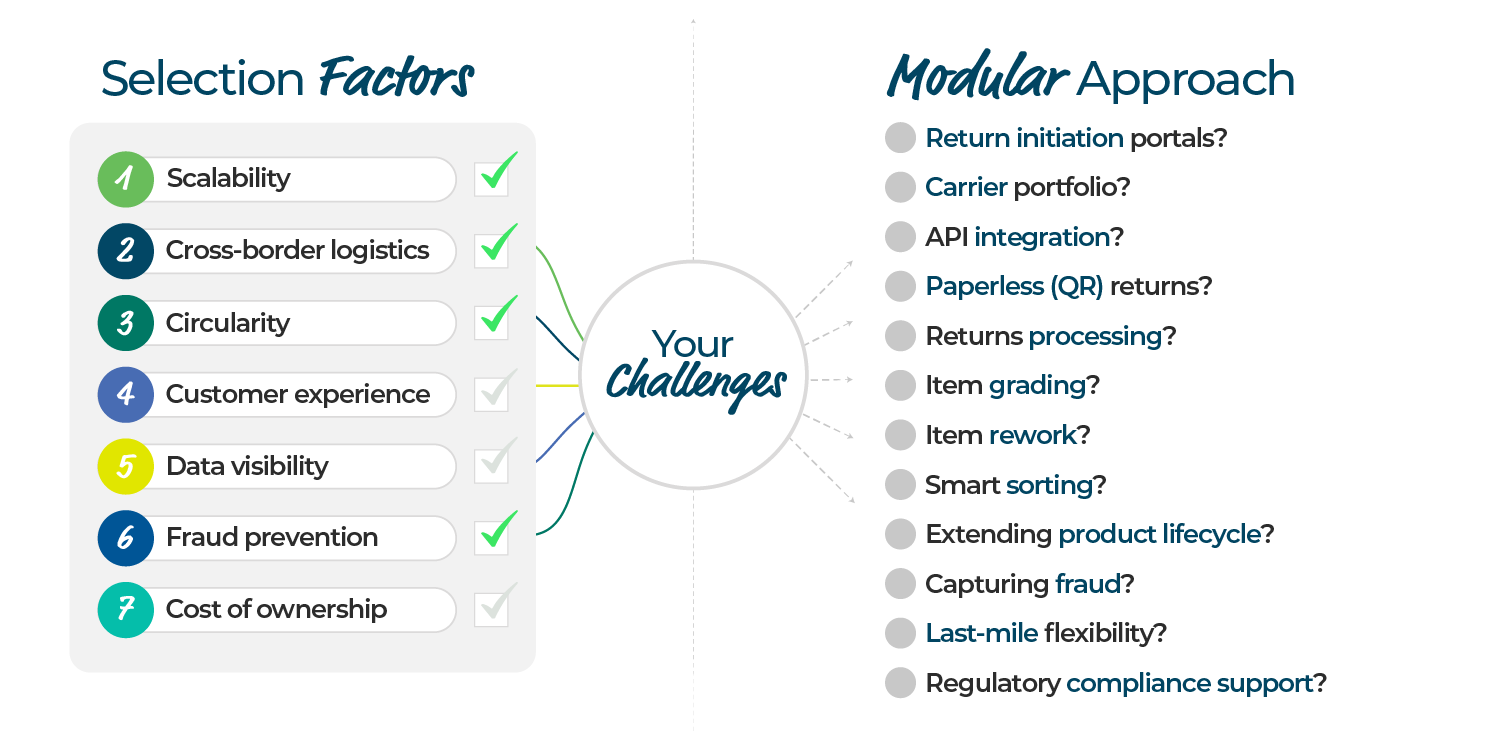
Each factor above connects to specific operational pain points. High return volumes stress your warehouse capacity and slow down refunds. Cross-border complexity adds cost and creates inconsistent customer experiences across markets. Lack of visibility means you’re reacting to return problems rather than preventing them.
The goal isn’t to find a provider that scores perfectly on every factor. Instead, identify where your current returns process creates the most friction and cost, then prioritise providers who address those specific challenges.
For large fashion brands, the combination of scalability, cross-border capability, and sustainability readiness typically carries the most weight. These are the factors that determine whether your returns operation can grow with your business while meeting increasingly stringent regulatory requirements.
What questions should you ask potential providers?
Beyond marketing materials and feature lists, the right questions reveal how a returns provider will actually perform in your operational context. Ask about specific scenarios rather than general capabilities.
Request references from fashion brands of similar size and complexity. Ask about implementation timelines and what internal resources you’ll need to commit. Understand how the provider handles exceptions and escalations when standard processes don’t apply.
Most importantly, ask how the provider will help you reduce returns over time, not just process them more efficiently. A true partner invests in understanding your products and customers well enough to identify prevention opportunities.
Why ReBound is the right choice for large fashion brands
ReBound delivers end-to-end returns management that combines technology and logistics into a single solution. Rather than piecing together separate providers for portal software, carrier management, and warehouse processing, you get one platform that handles the entire returns lifecycle.
ReBound processes millions of return transactions annually for fashion brands including ASOS, Allbirds, Columbia, Crocs, Gymshark, MANGO, Represent and other leading retailers. This scale brings efficiency advantages that smaller providers can’t match, from carrier rate negotiation to warehouse network optimisation.
The modular product structure means you can build a returns solution that fits your specific needs. Start with customer experience improvements, add processing capabilities as volumes grow, and layer in sustainability services as regulatory requirements evolve.
If you’re evaluating returns management software for your fashion brand, explore the Global Returns Guidebook for deeper insights into cross-border returns strategy, or get in touch with our team to discuss your specific requirements.
FAQs: Choosing returns management software for fashion brands
Fashion returns carry unique challenges including high return rates due to sizing and fit issues, seasonal depreciation that erodes value quickly, and the need for item-level inspection before restocking. ReBound addresses these through rapid local processing that minimises time in transit and rework capabilities that return items to sellable condition.
Implementation timelines vary based on complexity, but most brands can expect 4-8 weeks from contract to go-live. For example, ReBound offers guided implementation support and pre-built integrations with major e-commerce platforms that reduce technical lift on your side.
Yes, you can typically maintain existing carrier relationships where they make commercial sense. For instance, ReBound manages carrier contracts and provides access to an extensive returns network, but the platform’s flexibility allows you to blend carrier options based on cost, speed, and customer preference.
Items that can’t return to primary stock need alternative pathways. You should route products to resale channels, repair programmes, donation partners, or recycling facilities based on condition assessment. This approach helps fashion brands meet ESPR compliance requirements while recovering maximum value. ReBound’s circularity services cover all these capabilities.
Key metrics include refund speed (time from return initiation to customer credit), return rate by category and market, customer service contact rate for return enquiries, and value recovery rate on processed returns. ReBound provides analytics dashboards that track these metrics in real time.