
Blogs, Returns Strategy
Ecommerce Returns: How the Process Works and How to Choose the Right Solution
12 November 2026
Ecommerce returns are the full process of getting an online order back from the customer and resolving it, whether that ends in a refund, an exchange, store credit or the product going back into stock. It sounds simple. In practice it spans shipping, tracking, inspection, inventory and customer communication, and it becomes more complex with every new market you sell into.
The scale explains why it matters. The National Retail Federation estimated that 19.3% of online sales was returned in 2025, and 71% of consumers say they are less likely to shop with a retailer again after a poor returns experience.
This guide explains what ecommerce returns involve, what a returns service, software and processing should cover, how international returns change the picture and how to choose a provider. If you are already comparing options, our ecommerce returns solution page shows how ReBound manages the process.
Table of Contents
- Defining Ecommerce Returns Management
- Software, Automation and Integrations
- Connecting Ecommerce Returns Globally
- Choosing the Right Ecommerce Returns Solution
- Frequently Asked Questions (FAQs)
Key takeaways
- Ecommerce returns management covers return initiation, eligibility checks, shipping, receipt, inspection, inventory disposition, refunds or exchanges and data capture.
- Returns software automates the customer-facing steps: self-service requests, eligibility rules, labels, tracking, notifications and refund or exchange routing.
- Physical returns processing can include receiving, logging, inspection, grading, restocking, repackaging, refurbishment, recycling or disposal.
- Integrations with ecommerce platforms, carriers, warehouses, inventory systems and customer-service tools decide how completely a solution can manage returns.
- International returns add the complexities of cross-border shipping, customs documentation, duties and tax handling, longer transit times and market-specific policies.
What is ecommerce returns management?
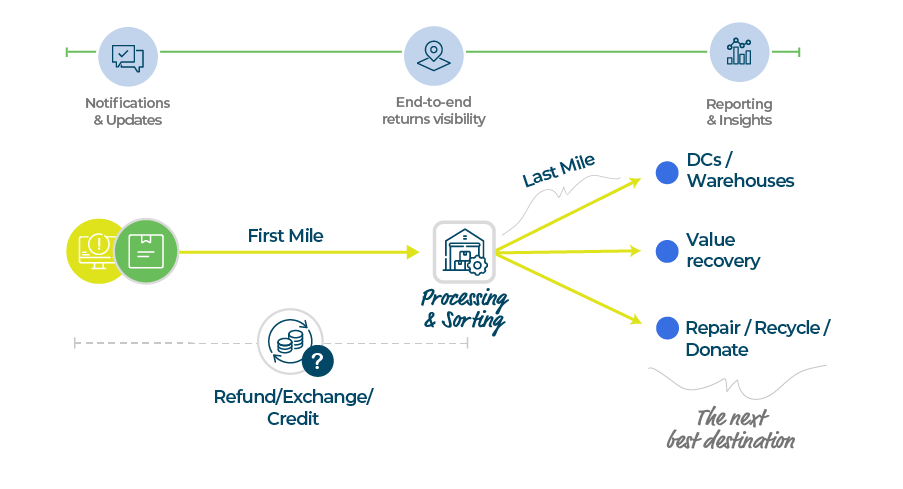
Ecommerce returns management is the coordination of everything that happens between a customer deciding to send an item back and the retailer resolving the return. It connects three layers that are often run separately: the customer-facing journey (software), the physical movement of parcels (carriers and logistics) and the handling of returned stock (processing).
That is why the terms around it can be confusing. A practical way to separate them:
- Ecommerce returns software is the tool. It handles requests, rules, labels, tracking and notifications.
- An ecommerce returns service is someone running part or all of the process for you, typically including carrier management, receiving and processing.
- An end-to-end ecommerce returns solution is the combination: software, logistics, processing and integrations working as one connected setup.
For the wider discipline, including how it differs from reverse logistics, see our returns management services page.
How ecommerce returns processing works, from request to refund
Most returns follow the same sequence. The difference between a smooth process and a costly one is how well the stages are connected.
| Stage | What happens | What to get right |
|---|---|---|
| 1. Request and eligibility | The customer identifies the order and item, gives a reason, and the retailer checks the request against policy. | Clear rules, consistent reason codes, and a customer-friendly way to start. |
| 2. Label and shipping | The customer receives a label or QR code and chooses a drop-off or collection option. | Local carrier choice, paperless options and clear costs. |
| 3. Tracking and updates | The parcel is tracked back and the customer is kept informed. | Visibility for both shopper and operations team, so fewer “where is my refund?” contacts. |
| 4. Receipt and inspection | The item arrives, is logged, inspected and graded. | Fast, consistent grading against agreed standards. |
| 5. Disposition | The item is restocked, repackaged, refurbished, recycled or disposed of. | Routing each item to its next best destination, not just back to a shelf. |
| 6. Resolution | The customer receives a refund, exchange or store credit. Timing depends on the retailer’s setup and can happen at different stages, such as at drop-off, on the first carrier scan or after inspection. | Triggering the outcome at the right moment, with the right checks. |
| 7. Data capture | Reasons, volumes, timings and outcomes are recorded. | Data that feeds product, policy and cost decisions. |
What does ecommerce returns processing include?
Ecommerce returns processing is the physical work done once a parcel reaches a returns facility: receiving, logging, inspection, grading, restocking, repackaging, refurbishment, recycling or disposal. The aim is to get sellable stock back on sale quickly and to make a sensible decision for everything else. Where reworking is needed, such as re-tagging, relabelling or cleaning, it is much faster when it happens in the same flow rather than as a separate project.
Ecommerce returns and fulfilment: keep stock moving
Returns and fulfilment share the same inventory. If returns processing is disconnected from the warehouse, good stock sits unsold while new orders are shipped from elsewhere. Capacity is a real pressure: NRF found that 60% of retailers have had to choose between shipping new orders and processing returns, and 40% cite rising processing costs as a top reason for charging for returns. Connecting ecommerce returns logistics to inventory and fulfilment systems reduces that trade-off. ReBound reworks returned items, such as re-tagging, relabelling and cleaning, so they come back ready to be resold immediately. As one of our client puts it, this gets “stock back and on sale faster”.
How should retailers manage returns exceptions?
Exceptions include items outside the return window, wrong or missing products, damaged goods, parcels without tracking and suspicious claims. The most effective approach is to define the rules in advance, route exceptions to review before a refund is triggered, and record the outcome so the rule can be improved.
Fraud is the exception retailers tend to underestimate. ReBound’s analysis of one million returned orders found £29 million in potentially fraudulent returns. A common gap is refunding before an item is inspected. Our Returns Fraud Playbook explains how risk-based decisions can protect margin without adding friction for genuine customers.
Returns software, automation and integrations
Returns management software automates the customer-facing side of the process. It lets shoppers start a return themselves, applies your eligibility rules, generates labels, shows tracking and sends notifications, then routes the outcome to a refund, exchange or store credit.
A branded consumer returns portal is the most visible part of this. A good one lets you set custom return windows and reason lists, supports multiple languages, shows local carriers and drop-off points, offers paperless QR code returns and keeps the shopper informed at each step.
How can retailers automate ecommerce returns processing?
Automation works best when it removes manual steps without removing control. The most useful starting points are:
- Rules-based eligibility, so out-of-policy returns are flagged at the start.
- Consistent return reasons, so data is usable later.
- Automatic labels and QR codes, so customers do not need a printer or customer service.
- Status notifications at every stage, so shoppers do not need to ask where their return is.
- Refund or exchange triggers tied to a drop-off or scan event, so refunds are fast and consistent.
- Exchange-first and store-credit options, so revenue stays in the business.
Which integrations matter most?
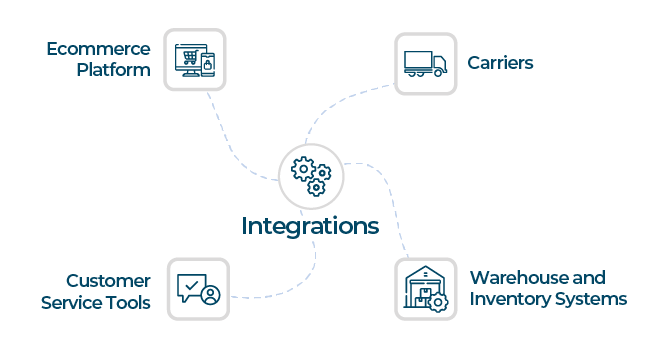
A returns solution is only as complete as the systems it connects to. The essentials are the ecommerce platform, carriers, warehouse and inventory systems and customer-service tools. Without them, teams re-key data, stock is not updated and customer service cannot see return status. If you already have a portal you like, an API connection can bring the returns operation behind it without changing the customer journey.
When you compare options, our returns management software evaluation guide sets out seven factors to assess, written with fashion brands in mind but relevant to most high-volume retailers.
How technology is changing ecommerce logistics
The biggest shift is that decisions are moving earlier. Instead of sending every return back to a central warehouse and deciding later, solutions such as ReBound’s dynamic routing can decide at the moment a return is initiated whether an item should be fast-tracked for resale, sent to an off-price partner or held locally. Combined with automated refunds and risk-based fraud checks, this turns returns from a delayed back-office process into a managed flow.
International ecommerce returns without disconnected workflows
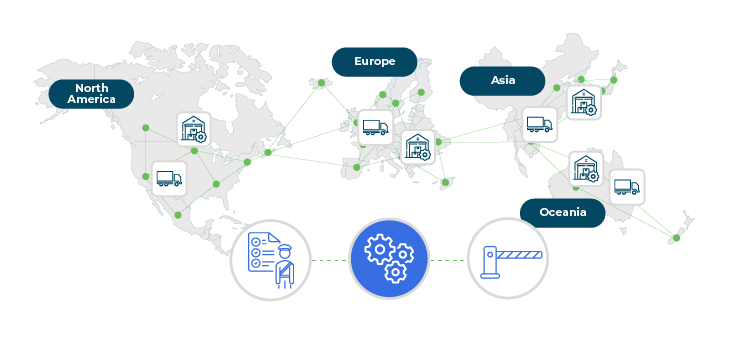
Inherently, managing global ecommerce returns are harder because every border adds a potential variable. On top of the regular returns flow, international returns add the complexities of cross-border shipping, customs documentation, duties and tax handling, longer transit times and market-specific policy requirements, plus the practical need for local language, currency and carrier options.
| Factor | Domestic return | International return |
|---|---|---|
| Carrier and drop-off | Familiar national options | Local carriers and drop-off points in each market |
| Transit time | Short and predictable | Longer, with more handovers |
| Customs and duties | Not applicable | Documentation, duties and tax treatment may apply |
| Policy and language | One policy, one language | Market-specific rules, language and currency |
| Visibility | Single carrier view | Needs one view across carriers and countries |
How do international ecommerce returns work?
In an international return, the shopper starts the return in their own language and picks a local carrier or drop-off point. The parcel is tracked to its destination, which could be a local hub or the retailer’s home warehouse. If it crosses a border, customs paperwork and duty rules apply. After receipt, the item is inspected, routed and resolved.
Connecting these steps in one workflow, with timely notifications for both your team and your customers, stops customer service from chasing multiple carrier portals and helps keep “where is my return?” contacts under control.
Rules that are changing the cost of cross-border returns
Regulation is now part of returns planning. From 1 July 2026 the EU applies a flat €3 customs duty per HS code category to low-value parcels, and that fee cannot be reclaimed when the customer returns the product. From 1 November 2026, an additional €2 EU handling fee is set to apply per item in the parcel, whatever the order value, and it is also non-refundable on returned goods. Learn more about this from our expert Technical Program Manager for Customs, Marissa van der Voort. Since 19 June 2026, online sellers serving EU consumers have also needed to offer a simple digital way to withdraw from a purchase. For goods returning to the UK, Returned Goods Relief can remove duty and import VAT if the goods come back unaltered within three years, but it has to be claimed and evidenced.
Should cross-border returns use local returns or in-country processing?
It depends on volume, product value and resale potential in each market. Sending everything back to a home warehouse is simple to set up but can mean slower refunds, higher shipping and customs exposure. Local returns and in-country processing shorten the journey and can get sellable stock back on sale faster, but require local capacity. A mixed model by market is often the practical answer: process locally where volumes and resale potential justify it, and consolidate elsewhere.
ReBound supports both approaches through a network covering 150+ countries, 300+ carrier services and 40+ local hubs, so retailers can ship returns back to their own warehouse or process them through ReBound’s. For a deeper look at scaling across markets, download The Global Returns Guidebook.
How to choose an ecommerce returns solution or service
Retailers often start by asking what the best logistics solutions for online retailers are. For returns, the better question is which provider covers the whole returns journey, not just one leg of it. The same applies to the best retail logistics solutions for ecommerce growth: they have to scale as markets, channels and peak volumes increase.
Use these questions to compare providers:
- Scope. Is it software only, logistics only or fully managed? What exactly is included?
- Network. Which carriers, drop-off points and hubs cover the markets you sell into?
- Processing. Who inspects, grades, reworks and routes returned stock, and how quickly?
- Integrations. How does it connect to your ecommerce platform, warehouse, inventory and customer-service tools?
- Visibility. Can your team and your customers see the status of every return?
- International capability. How are customs, duties, languages and local carriers handled?
- Control. How are exceptions, fraud and peak volumes managed?
Retailers that sell across more than one channel should also check whether store and marketplace returns can run through the same process. Our omnichannel returns page explains how that works. For a broader guide, please refer to our Returns Management Software Evaluation Guide.
Frequently asked questions about ecommerce returns
An ecommerce returns service typically covers the physical and operational side of returns: return initiation, carrier and drop-off options, tracking, receiving, inspection, grading, restocking or other disposition, and the data needed to trigger a refund, exchange or store credit. Some services also include the returns portal and integrations, while others cover logistics and processing only, so always confirm what is in scope.
The shopper starts the return in their own language and chooses a local carrier or drop-off point. The parcel is tracked to its destination, which may be a local processing hub or your home warehouse. If it crosses a border, customs documentation and any duty or tax treatment apply. Once received, the item is inspected, routed to its next destination and the refund or exchange is triggered.
A returns solution should connect to your ecommerce platform, carriers, warehouse and inventory systems, and customer-service tools. ReBound, for example, offers a Shopify integration and API connections for retailers that already have their own portal, and manages a network of more than 300 carrier services. Always check that integrations are live in your target markets, not just available in principle.
A swap return, often called an exchange, lets the shopper send back an item and receive a replacement, usually a different size or colour, instead of a refund. In a connected flow the shopper picks the replacement inside the returns portal and the item is reserved against live stock when the label is created. Whether the replacement ships immediately or after the return is scanned is a retailer policy decision.
Compare providers on scope (carrier-only, software-only or end-to-end), network coverage in your markets, returns-specific capabilities such as tracking, processing and refund triggers, integration depth, data visibility and international experience. Outbound delivery strength does not guarantee returns strength, so ask for returns performance data and references in the markets you sell to.
Image, Team of ReBound professionals having a conversation, smiling at each other. They are holding notebooks, tablets and a laptop. ReBound branded merged arrows passing through them.
Simplify ecommerce returns with a connected approach
Ecommerce returns work best when software, logistics and processing are designed as one flow, across every market you sell into. If you want to see how that looks in practice, explore ReBound’s ecommerce returns solution or speak to the ReBound team about your returns operation.